Address:
Plot No. B-6/5, Site 5 Surajpur Industrial Area, Block F, Surajpur Site V, Greater Noida, Uttar Pradesh 201306
For Business: +91 9212314779
For Careers: +91 84483 40400
Landline: 0120-4298000
Address:
Plot No. B-6/5, Site 5 Surajpur Industrial Area, Block F, Surajpur Site V, Greater Noida, Uttar Pradesh 201306
For Business: +91 9212314779
For Careers: +91 84483 40400
Landline: 0120-4298000


Solar inverter monitoring is moving from isolated plant-level visibility towards connected, centralised data systems. For inverter manufacturers and solar RMS companies operating under evolving regulatory requirements, the communication layer is now an important part of product architecture.
National server connectivity adds another requirement to this architecture. The inverter must not only collect operating data but also communicate through an appropriate device, network and software stack so that relevant information can reach the designated central infrastructure.
This makes the design of a solar RMS more than a dashboard project. It involves inverter communication, data acquisition, local storage, network connectivity, secure transmission, server integration, data validation and monitoring.
For companies developing or deploying solar inverters under the PM Surya Ghar framework, understanding this complete architecture is important before selecting a communication device or solar data logger. HBeonLabs’ current data logger offering, for example, includes M2M SIM communication, National Server connectivity, 4G and Wi-Fi options, multiple local interfaces and cloud-based monitoring capabilities.
National server connectivity refers to the ability of a solar inverter communication system to transmit required inverter data to designated central server infrastructure.
The inverter itself generally does not connect directly to the internet. Instead, a communication device or data logger collects information from the inverter through interfaces such as RS485, RS232, TTL or USB. The data logger then uses an available network connection, such as 4G or Wi-Fi, to transmit the information to the appropriate server or monitoring infrastructure.
A simplified architecture looks like this:
Solar Inverter → Data Interface → Data Logger → M2M SIM/Wi-Fi → Internet Network → National Server → Monitoring and Reporting System
Each layer has a specific function.
The inverter generates operational data. The communication interface makes that data available. The data logger receives and processes it. The network provides connectivity. The server receives and stores the transmitted information for centralised monitoring, analysis or reporting.
This separation is important because communication failures can occur at any layer. A reliable system therefore needs to be designed as an integrated communication architecture rather than as a standalone monitoring device.
Solar installations can be distributed across thousands of locations. A centralised server architecture allows data from these installations to be collected in a consistent format and made available for monitoring and system-level analysis.
For inverter manufacturers, this changes the way communication hardware must be considered during product development.
A communication device needs to support:
MNRE-related requirements referenced on HBeonLabs’ data logger page include M2M SIM communication and National Server connectivity for solar inverter communication devices. The same page identifies integration testing requirements and describes its data loggers as supporting these requirements.
The exact regulatory and technical requirements should always be checked against the latest official MNRE documentation applicable to the project.
A national server connected RMS generally consists of several interconnected layers.
The inverter is the primary source of operational data.
Depending on the inverter design, information may include:
The available data depends on the inverter hardware and firmware.
Before selecting a data logger, manufacturers should establish exactly which parameters need to be collected and how those parameters are exposed through the inverter’s communication interface.
The next layer connects the inverter to the communication device.
RS485 is commonly used in industrial and solar electronics because it supports robust serial communication over field connections. Other interfaces can include RS232, TTL and USB.
However, an interface and a communication protocol are not the same thing.
For example, RS485 defines the electrical signalling method, while Modbus RTU can define the structure of the data exchanged over an RS485 connection.
This distinction matters during integration. A data logger may have an RS485 interface, but the inverter’s register map, baud rate, device address, parity and supported commands must also be compatible.
The data logger acts as the communication bridge between the inverter and the remote server.
Its responsibilities can include:
This makes the solar power data logger a critical component of the overall RMS architecture.

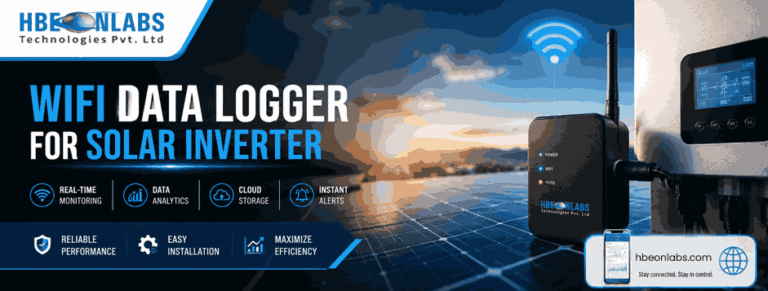
HBeonLabs’ DLWU model supports Wi-Fi connectivity, BLE 5.2 and USB, RS485, RS232 and TTL interfaces. Its published specifications also include local flash memory and configurable data intervals. The DL4GU model uses LTE Cat 1 connectivity and supports encrypted two-way communication, OTA firmware upgrades and breakpoint resuming.
Once inverter data has been collected, it needs a reliable communication path to the server.
The choice of network depends on the installation environment.
Wi-Fi can be suitable where the solar installation has reliable local network infrastructure.
Its main limitation is dependence on the availability and stability of the local network. For distributed rooftop installations, this needs to be considered during system design.
4G connectivity provides an independent communication path where suitable cellular coverage is available.
For large-scale deployments, M2M SIM-based communication can simplify device connectivity and management. The communication device can transmit data without depending on the customer’s local Wi-Fi infrastructure.
HBeonLabs’ DL4GU uses 4G LTE Cat 1 communication and provides encrypted two-way communication, OTA firmware upgrades and breakpoint resuming support.
Sending raw inverter data directly to a server is not enough.
The communication layer should identify whether the data received from the inverter is valid before transmission.
For example, the system may need to identify:
Data validation at the device level helps prevent unreliable information from entering the central monitoring system.
For distributed solar installations, timestamp management is also important. Server-side systems need to understand when a measurement was generated, when it was received and whether the data represents a current reading or a delayed transmission.
Network connectivity cannot be assumed to be continuous.
A solar installation may temporarily lose cellular connectivity because of network conditions, power interruption, SIM issues or other communication problems.
If the data logger immediately discards measurements during such an outage, the monitoring platform can develop gaps in its historical records.
Local storage provides a way to temporarily retain data until communication is restored.
Breakpoint recovery is another useful function. Instead of treating a transmission interruption as a complete failure, the device can resume transmission from the point where communication stopped, depending on the system architecture.
HBeonLabs lists breakpoint resuming as a feature of its data logger solutions.
For an RMS deployment, this capability should be evaluated alongside memory capacity, transmission frequency and the expected duration of network interruptions.
The server integration layer is where the communication device connects with the designated central infrastructure.
Integration should define:
The communication device should not simply establish a network connection. It must be capable of exchanging information according to the technical requirements of the target server.
This is why integration testing needs to be considered early in the product development cycle.
A data logger may work correctly with an inverter in a laboratory environment but still require additional configuration or firmware work before it can communicate correctly with a designated server.
One of the biggest considerations for inverter OEMs is compatibility with existing product architectures.
A communication device should be evaluated against the inverter’s:
For example, if an inverter exposes data through RS485 and Modbus RTU, the data logger must support the relevant communication settings and register structure.
If multiple inverter models are being deployed, the communication architecture may also need to support different register maps.
This makes firmware configuration an important part of an RMS solution.
National-scale solar infrastructure requires careful attention to communication security.
The communication architecture should consider:
The server should be able to identify legitimate devices connecting to the infrastructure.
Data transmitted over public networks should use appropriate security mechanisms.
If devices support OTA updates, the update process should prevent unauthorised firmware from being installed.
Remote management functions should be protected so that only authorised users or systems can access them.
Network credentials, server configuration and device settings should be protected against unauthorised access.
HBeonLabs states that its DL4GU supports encrypted two-way communication, OTA firmware upgrades and local and remote debugging.
These features should be evaluated in the context of the complete deployment architecture rather than as isolated product specifications.
A well-designed RMS should have defined behaviour for communication failures.
Consider a rooftop inverter that loses cellular connectivity for 30 minutes.
The data logger should ideally continue collecting the available inverter data locally. Once connectivity returns, the device can transmit the stored records according to its recovery logic.
A typical process is:
Inverter data collection → Network failure → Local storage → Network recovery → Data transmission → Server acknowledgement → Normal operation
This approach helps maintain continuity in the historical dataset.
For large solar portfolios, this is particularly important because manually identifying missing data across hundreds or thousands of installations can be time-consuming.
National server connectivity and cloud monitoring serve different purposes within a broader architecture.
The central server provides the required data exchange and centralised infrastructure. A monitoring platform can then provide operational visibility through dashboards, alerts, reports and historical analysis, depending on the system design.
An RMS platform can present information such as:
HBeonLabs describes its solar monitoring architecture as providing real-time visibility, cloud-based monitoring, fault reporting, remote access and historical data capabilities.
For EPC and O&M teams, this operational layer can be particularly useful because the same data collected for compliance and central reporting can also support day-to-day monitoring.
A charge controller for solar panels performs a different function from an inverter data logger, but it can also form part of a connected solar system.
The charge controller regulates energy flow between photovoltaic panels and a battery in applicable solar systems. Depending on the equipment, it may expose information such as voltage, current, battery status, temperature and fault conditions through communication interfaces.
When a charge controller is integrated into a wider monitoring architecture, its data can potentially be collected through a gateway or compatible communication device.
This reinforces an important principle in solar electronics: communication architecture should be considered alongside the core electrical function of the equipment.
The interface, protocol, data format and monitoring requirements all need to be compatible before integration.
Before selecting a data logger or RMS provider, inverter manufacturers should evaluate the following:
| Area | What to verify |
| Inverter interface | RS485, RS232, TTL, USB or other supported interface |
| Protocol | Modbus or applicable communication protocol |
| Data parameters | Required inverter measurements and status values |
| Network | 4G, Wi-Fi or other supported connectivity |
| M2M | SIM and connectivity management requirements |
| Local storage | Memory capacity and outage handling |
| Data recovery | Breakpoint or retry mechanism |
| Security | Encryption, authentication and access control |
| Server | Endpoint, protocol and data format requirements |
| Firmware | Remote configuration and OTA update capability |
| Environment | Temperature, humidity and installation conditions |
| Testing | Inverter, communication and server integration testing |
| Documentation | Register maps, protocols and integration documents |
This checklist helps engineering and procurement teams evaluate the complete solution rather than selecting a communication device based only on connectivity.
National server connectivity should not be added after the inverter has already been finalised.
The communication requirements can influence hardware interfaces, power consumption, firmware architecture, memory requirements, enclosure design, network configuration and testing procedures.
Early integration also allows manufacturers to identify compatibility issues before large-scale deployment.
A practical development process can include:
Requirement definition → Interface mapping → Data model → Communication firmware → Data logger integration → Network testing → Server integration → Security testing → Field testing → Production deployment
This approach gives the engineering team a clear path from inverter-level communication to centralised monitoring.
At HBeonLabs Technologies Pvt. Ltd., we work across electronics, embedded systems and IoT solutions, including solar monitoring and data logger applications. Our published solar data logger solutions include Wi-Fi and 4G LTE variants with interfaces such as RS485, RS232, TTL and USB, along with local data storage, configurable transmission intervals, cloud integration and remote monitoring capabilities. Our DL4GU also supports encrypted two-way communication, OTA firmware upgrades and breakpoint resuming.
We also provide a broader electronics development capability covering R&D, embedded technology, IoT and electronics manufacturing. This allows us to approach solar RMS integration from both the communication and hardware perspective. For inverter manufacturers and solar technology companies, the practical requirement is not simply to install a data logger. The communication device, inverter interface, network connectivity, data handling and server integration need to work together as one system.
National server connectivity changes the role of solar inverter communication from a basic monitoring feature into an important part of the system architecture.
For inverter manufacturers, the key considerations extend beyond selecting a 4G or Wi-Fi device. The complete chain needs to be evaluated, including inverter interfaces, communication protocols, data acquisition, local storage, M2M connectivity, secure transmission, server integration, failure recovery and testing.
A properly designed solar RMS can provide the communication infrastructure needed to connect field-level inverter data with centralised systems while also supporting operational monitoring.
The solar power data logger sits at the centre of this architecture by connecting the inverter to the network and handling data transmission. Where other solar equipment such as a charge controller for solar panels is part of the connected system, its communication requirements should also be considered during system design.
For solar OEMs, EPC companies and system integrators, the most practical approach is to define the communication and server requirements early, validate inverter compatibility, test the complete data path and select hardware and software that can support the intended deployment at scale.
1. What is National Server connectivity for solar inverters?
National Server connectivity enables solar inverter data to be transmitted from the inverter through a communication device or data logger to designated central server infrastructure. The architecture typically includes the inverter, communication interface, data logger, network connection and server.
2. What role does a solar data logger play in National Server connectivity?
A solar data logger collects operational data from the inverter through interfaces such as RS485, RS232, TTL or USB. It can process and store the data locally before transmitting it through 4G, Wi-Fi or another supported network to the required server.
3. Why is M2M SIM communication important for solar inverter monitoring?
M2M SIM communication allows connected solar equipment to transmit data over cellular networks without depending on a customer’s local Wi-Fi network. It can be useful for distributed solar installations where consistent remote connectivity and device-level communication management are required.
4. What should solar inverter manufacturers check before integrating an RMS data logger?
Manufacturers should verify inverter interfaces, communication protocols, register maps, required data parameters, network connectivity, local storage, data recovery, security, server requirements, firmware capabilities and integration testing requirements. Compatibility should be established before large-scale deployment.
5. Can a solar RMS continue collecting data when network connectivity is interrupted?
Yes, depending on the data logger and RMS architecture. A system with local storage can retain inverter data during a temporary network outage and transmit the stored information after connectivity is restored. Features such as breakpoint recovery can help resume interrupted data transmission.